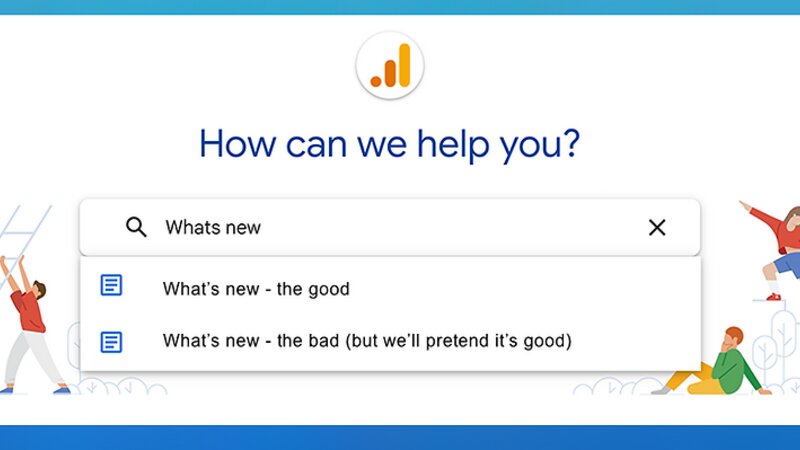
Since January, Google has rolled out 44 GA4 updates, as listed on their 'What's New' page. These releases ranged from impactful improvements to tone-deaf updates, stirring both celebration and frustration within the community. Yet, it's undeniable that this year has been a whirlwind of excitement for Google Analytics.
Here's my rundown of the Top 5 improvements and Top 5 duds from the 2023 Google Analytics 'What's New' list.
Top 5 Improvements
1. Custom Channel Groupings (Mar 14)
A key limitation of GA4 in its early stages was the inflexibility of the 'Unassigned' channel. This category, a dumping ground for a mishmash of referrals, UTMs, and various attribution sources, seemed like a dead end. The March update changed the game by empowering users to craft their own channel groupings and dynamically reassign sources according to their unique criteria.
2. Ecommerce Dimensions (Jan 10, Mar 16, May 17, Jul 10, Dec 5)
GA4, initially lacking many of UA's valuable ecommerce reporting features, has seen significant enhancements. It's puzzling why accessing actual sales requires delving into the Order Coupon report, the sole home of the transaction_id by default. This year, GA4 devoted substantial updates to expanding item-scoped dimensions. These enhancements have not only made ecommerce data more flexible by allowing the addition of custom item dimensions but also improved accessibility, enabling their use across most GA4 features (audience builder, explore, bigquery).
3. Audience Updates (May 17, Jun 26, Jul 27, Aug 1, Nov 10, Dec 5)
A personal highlight in GA4 has been the audience functionality, a powerhouse of rich and versatile features. This year's updates have brought considerable enhancements, making the audience builder more adaptable and user-friendly. Key advancements in 2023 include the introduction of audience reports and the integration of the Audience Builder with Google Ads and Salesforce. The ability to export data via API opens up new possibilities for developing applications that utilize this data effectively. Moreover, the audience reports and dimensions provide a level of flexibility in segmenting data that UA simply couldn't match.
4. User Data in BigQuery (Sep 18)
This update marked a significant advancement for GA4. By facilitating access to raw user data, it enhances our capability to merge GA4 data with other datasets using unique identifiers. This integration not only enriches the data significantly but also allows for a more streamlined, user-centric view of audience information. Additionally, it provides insights into Lifetime Value (LTV), a concept barely touched upon in Universal Analytics.
5. Google Signals Gone from Reporting (Oct 2, Email on Dec 7)
Google Signals had been a source of considerable confusion in reporting, primarily due to its data thresholding feature. This led to the disappearance of events that failed to meet a minimum threshold, creating gaps in data. Coupled with issues of sampling and cardinality, it rendered Google Analytics data difficult to both comprehend and trust. Responding to persistent community feedback, Google's first significant step was to introduce an option to disable Google Signals in reporting. Eventually, Google sent out a mass email stating that Google Signals would no longer be included in reports at all — a change widely welcomed, providing much-needed clarity and reliability to the data.
Top 5 Duds
1. Modify and Create Events Using Regular Expressions (Apr 3)
Regular expressions (regex) were a standout feature in Universal Analytics, known for their power and popularity. They offered the flexibility to add conditions beyond the simple 'contains' or 'equals,' opening up a lot of possibilities. So naturally, there was buzz of excitement when regex was introduced in GA4. However, that excitement quickly soured when users discovered that any regex implemented would be processed directly in the end user's browser.
GA4 attempts to run through every possible combination (backtracking) in the user's browser to determine if a regex matches the criteria. This process could potentially overwhelm and even crash a user's browser. This update is a potential minefield for those unaware of its implications — a poorly executed response to a straightforward request.
2. Search Improvements (Jan 30)
In its pursuit of advancements, Google Analytics veered towards Machine Learning Insights and Machine Learning Search. However, instead of adopting an inventive LLM model, Google opted for a standard, somewhat rigid search model that primarily offers quick responses to basic queries, most of which could be easily found within the interface. It feels like Google is phoning it in with their AI features instead of providing anything revolutionary.
3. UI 'Improvements' — Admin Interface Change & Auto Creation of Business Objectives (June 1, Nov 14)
On one hand, GA4's interface, which feels somewhat cobbled together, certainly needs refining. On the other hand, Google's efforts to 'fix' the interface in 2023 led to more confusion than clarity. The reorganization of the Admin section, lumping various elements under generic 'data' labels without removing redundant wording, only complicates navigation. Moreover, the introduction of the 'business objectives' library collection, just as users were getting the hang of the Life Cycle collection, resulted in overwhelmingly cluttered sidebars and a redundant categorization of GA4 reports.
4. '(Other)' Category and Increased Segmentation — Communication Issues (Feb 15, Nov 27)
GA4's journey often feels like two steps forward and one giant leap back. A prime example is Google's decision to increase data segmentation and the prevalence of the '(other)' category in reports. This move only exacerbated the challenge of extracting clean data from the GA4 interface. Adding to the frustration, these changes were paradoxically touted as improvements, a claim that seems disconnected from user experience.
5. Removal of Attribution Models (Oct 17)
In a significant shift, GA4 phased out all attribution models except for 'last touch' and 'data-driven.' While some users welcomed this simplification, others found it limiting. The one that stings most is the removal of the 'first-click' attribution model. Oddly enough, GA4 seems to be heavily built on user-level first-touch attribution, despite its lean towards a data-driven model in certain reports. The decision to remove first-click attribution from the models, yet retain its presence across many other reports, is puzzling.
The Verdict
Overall, these updates signify major shifts in GA4. Whether for better or worse, they certainly point to Google Analytics evolving towards a distinct, albeit mysterious, direction. The big question lingers: will GA4 continue to be the preferred choice for marketing analytics going forward? With the ever-evolving landscape of digital marketing, it's sure to be an exciting ride.