Content is the glue that binds cross channel marketing together (SEO, social, paid, email…everything).
However, so many marketing teams are misinformed about what good content is due to — ahem — "advice".
Because of this, companies are cranking out content at an alarming rate — 2.5 quintillion bytes of data are created each day.
Here at From The Future, we love content — it's the backbone of our brand strategy (and our clients'). I'm not telling you to create less content, I'm telling you to create better content.
That's what we're going to discuss in this post — how to clean up and improve your website's existing assets by running a content audit.
Why do you need a content audit?
When I say "content", I don't mean just blog posts – I mean your entire website:
- Legacy product / service pages
- Irrelevant category or auto generated "tag" pages
- Dated blog, resource or informational pages
- Doorway pages that don't connect to your site's core architecture
- Subdomains, forums, staging domains, etc.
OK…But WHY does cleaning up "bad" content matter? Let's unpack this a little more...
- Content that doesn't resonate with your target audience will kill conversion and engagement rates.
- Google's algorithm looks heavily at content quality, trust and relevancy (AKA having crap content can hurt rankings).
- Too much low-quality content can decrease search engine crawl rate, indexation rate and ultimately, rankings.
We had great content, what happened?
This happens all the time with clients, and it could be for a number of reasons:
- Google's algorithm. The algorithm is changing all the time and you have to keep up with it.
- Market saturation. New products can be hitting the market or your competitors are becoming more sophisticated in their content marketing.
- Your audience. Their needs might have evolved, changed, etc.
- Outdated posts. The old content on your site has gone stale.
- Keyword cannibalization. This means that you have content that is directly competing with your other content.
This is a simplistic view, but we often see trends in our client's content campaigns that point to diminishing returns of content over time:
- Initial leap — Immediately after publishing, content usually sees solid performance if it's being promoted properly through channels other than SEO (social, paid, etc.).
- Initial drop — Once it's not being as promoted thoroughly, traffic will stop rising and begin to drop.
- Slow growth — SEO-focused content will continue to grow in the short-to-mid term as it picks up more keywords and links.
- Leveling out — Content growth crawls to a stop and stays there. This can last for months.
- Decline — Unless you continuously work on maintaining them, your rankings will eventually drop off.
- Decision time — Make a choice about what you're going to do to improve the content.
The bottom line: content marketing and SEO performance is an ongoing task. Your content needs to be regularly reviewed (yearly) to ensure peak performance.
What will a content audit accomplish?
A content audit will identify content that needs to be removed, improved, optimized or rewritten. If executed properly, a content audit will greatly improve the performance of your existing assets and lay the groundwork for future creation as well.
At the macro level, a content audit will answer:
- What content is performing best?
- What content is my audience connecting with?
- Which content is unnecessary or even detrimental?
- How can I improve my overall strategy?
And at the micro:
- Which pages represent the best opportunities for optimization?
- Where are the gaps in my content? Overlaps? Cannibalization?
- Are there pages with high traffic but low conversions?
- How should we allocate our content resources going forward?
Critical concept — building topical authority
We like to drill home the concept of approaching content through the lens of topical authority.
This helps Google see your website as an authority of these topics, which helps you pick up rankings across your site.
We help our clients execute this concept by modeling keywords into topic clusters. This means to build subtopics around a core topic. If your core topic is business loans, for example, subtopics can include:
- Business loans for small businesses
- Business loans for real estate agents
- Business loans for accountants
When we run a content audit this concept is critical to organizing content and planning for future assets.
The key is to start thinking in terms of topics you want to own, not just keywords. Without using topic clusters, your content exists under one general umbrella. What you should strive for is focused topics with content built around them — hub-and-spoke architecture that signals deep expertise.
Compiling the right data for your audit
We need to make sure our decisions are backed by data. Google Analytics isn't enough — we want as much data from relevant sources as possible.
Our agency uses the Website Quality Audit (WQA) as a means to compile and organize everything we need.
The Website Quality Audit (WQA)
Search engines send traffic to websites they deem as "high quality." High quality can be defined as websites that:
- Are coded and structured according to their webmaster guidelines.
- Are popular.
- Have content that speaks to a specific intent (answers a specific question).
Having low-quality pages, content, poor structure and lack of web mentions causes Google to lose trust in your website and crawl, index and rank it less and less over time.
The WQA pulls data from 5 vital SEO sources:
- A site crawler
- Ahrefs
- SEMRush
- Google Analytics (GA)
- Google Search Console (GSC)
We use Google Sheets to aggregate all of the data because of the add-on features and ability to collaborate across teams in real time.
1. A full website crawl
We crawl a site to get information on the internal URLs, crawl depth, HTTP status code, and much more. Some site crawlers that we use are Sitebulb, Deepcrawl, and Screaming Frog. We've been leaning more on Sitebulb because of the technical SEO hints that it provides.
2. Next, we pull in performance data
We pull in data from Ahrefs (backlinks and referring domains), SEMRush (current keyword rankings, positions, monthly search volume, etc), Google Analytics (PageViews and sessions per URL) and Google Search Console (organic clicks, impressions, CTR, and average position). We use URL Profiler and/or Super Metrics to download all of this data.
3. Organizing the data
Organizing data comes to having different tabs in Google Sheets and organizing them accordingly. One tip would be to create a template in Google Sheets, and create a copy and just use that for every website quality audit that you conduct.
The final product has every URL on your website with every piece of SEO data you can imagine. We then use this data to evaluate your options.
Making data-driven decisions about content
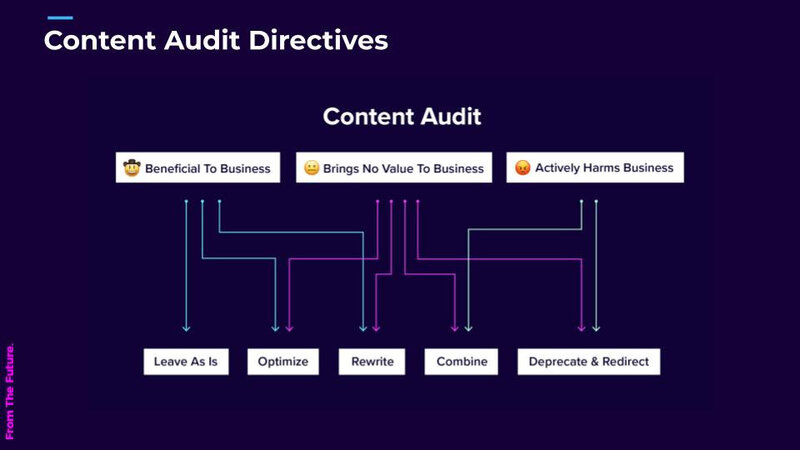
Now that you have data, you want to know what you can do next about the content on your site. Your content will fall into three categories:
- Content that is beneficial to your business
- Content that brings no value to your business
- Content that actively harms your business
These feed into five directives — the decisions that you can make with the content:
- Leave as is. The content is performing well, gaining traffic through marketing channels apart from SEO or is essential to the user funnel. It should not be changed.
- Optimize. The content has potential but needs improvements to on-page content and page structure in order to perform well in search. These are marginal improvements, not wholesale changes.
- Rewrite. The content topic has potential to rank for relevant terms, but will need a complete rewrite to perform competitively. It's a good idea, it just doesn't perform.
- Combine. Multiple pieces of content on a very similar topic can be combined into a singular page that has higher potential to rank for relevant keywords. This combats keyword cannibalization.
- Deprecate and redirect. The content is not performing well in search and has very low potential to improve. It should be deprecated and redirected to an existing relevant page.
These shorthand data sources help you make these decisions quickly:
- Overall traffic. Set a metric for "valuable" traffic. A good baseline is that if something gets less than 20 organic sessions over the past 90 days, it usually isn't worth keeping around.
- Keyword rankings. If something has high impressions with low clicks, think about optimizing the metadata. If the average keyword position is in the 5–20 range, also consider optimizing or rewriting.
- Backlinks and referring domains. If a URL has backlinks and/or referring domains, but no traffic, it has SEO value — think about using that to help other pages through redirect.
Before you go ahead and delete your entire site because it doesn't get any traffic, think about these things:
- Pruning pages will not likely create a windfall of traffic. Don't just pick out all of your content. There will be some value for some consumers.
- Bigger sites benefit the most — smaller sites should be careful.
- Evaluate the page itself before making a decision.
Content audit example
Let's run through some example directives from our client OnDeck.
Directive #1 — Leave As Is
There was only one URL on the blog that we recommended "leave as is" — an article about small business articles 2017:
- It was a specific keyword
- It ranks for 47 keywords
- Ranks 1st for "Business Articles 2017," a term with 800 MSV
- Gains roughly 400 organic visits per month, as per Ahrefs
However, one caveat would be that it ranks fourth for "small business articles" which may or may not be a valuable term.
Directive #2 — Optimize
OnDeck.com had a post about "3 Financial Trends to Watch in 2018." We recommended optimization because:
- It ranks fourth for "Finance Trend," 9th for "Financial Trends" and is top 15 for related terms
- The article was poorly formatted and could be easily optimized
- The article was written for 2018
There are a ton of ways to optimize pages. At From The Future, we generally follow 8 steps:
- Ensure that the page titles targets priority keywords
- Rewrite the H1 in an engaging way that also targets keywords
- Rewrite the meta description to make it more engaging
- Use keywords in article subheaders (h2s, h3s, etc.)
- Evaluate the URL slug for proper organization and targeting
- Ensure images are optimized with alt text
- Collect data on semantic keywords to make sure the page aligns with search intent
- Make specific changes or recommendations to body text if necessary
Directive #3 — Rewrite
This post was about "Three Effective Sales Tactics," which we chose to rewrite:
- It ranks in teens for several relevant terms, including "sales tactics" which has an MSV of 900
- Existing content is very thin for scope of topic and poorly organized
Directive #4 — Combine
OnDeck had two posts called "Find The Right Business Loan" and "Small Business Loan Requirements." We combined these because:
- These articles have the same intent — educating users about the requirements for getting a loan
- It didn't have direct cannibalization, but had a big opportunity to combine unique content to create a better resource
Directive #5 — Deprecate and Redirect
OnDeck had a post called "Bookkeeping Tips For 2015." We recommended deprecating and redirecting this post because:
- The post gained no organic traffic
- It's outdated
- It was too thin
Wrapping It Up
Creating and iterating content is extremely frustrating, especially when your business' performance continues to stay down on a slump.
By following this article, you should be able to confidently diagnose any problems with your content. A content audit isn't a one-time project — it's a yearly discipline that separates brands that grow from brands that stagnate.
The bottom line: if you're not regularly auditing your content, you're leaving rankings, traffic, and revenue on the table.